
Article written by Veronika Melkozerova in Kyiv and Eva Hartog
Originally published by politico.eu (Jan 23, 2024)
But Russia is fighting back with its own front-line feline videos.
Wars are fought by soldiers using bullets, shells and missiles, but also with ideas and propaganda — which explains why cats have become the latest battlefront in Ukraine.
Ukraine’s social media are full of felines, showing how they help soldiers as emotional support animals, attract donations to the military with their fluffy cuteness, and also fight invaders — in this case mice.
Russia is fighting back by humanizing its invading soldiers — often used in “meat wave” attacks against Ukrainian positions and accused of atrocities against civilians — by showing them with their own cats.
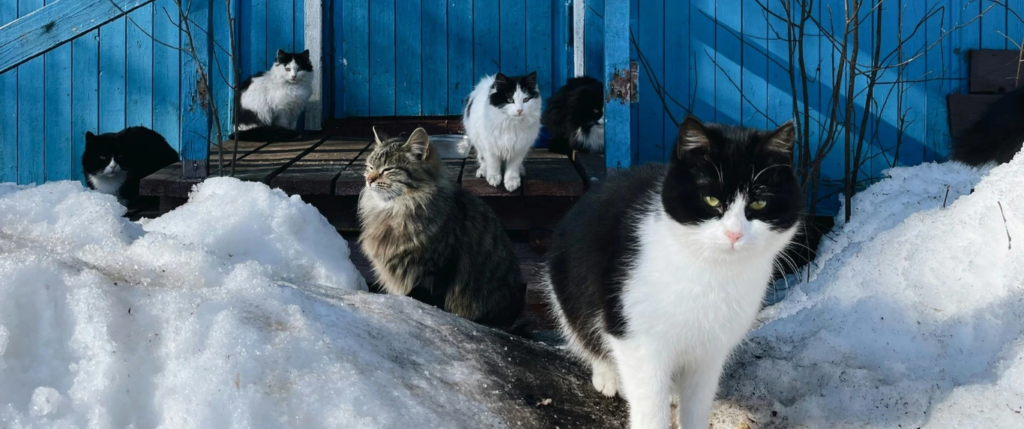
Cats usually arrive at Ukrainian army positions from nearby villages or towns destroyed by war. Abandoned by their owners, the pets seek human protection from the constant shelling, drone strikes and minefields.

“When this scared little creature comes to you, seeking protection, how could you say no? We are strong, so we protect weaker beings, who got into the same awful circumstances as we did, just because Russians showed up on our land,” explained Oleksandr Yabchanka, a Ukrainian army combat medic.
Cats and other animals bring comfort to Ukrainian soldiers. “Some adopt them and take them home, others prefer to keep them in the trenches and even pass them on to other units during rotation,” said Oleksandr Shtupun, a Ukrainian army spokesperson.
The adopted felines also fight their own battles against the mice that infest the trenches and chew Starlink satellite comms cables and car wiring, destroy food supplies and military gear, and even nip the fingers of sleeping soldiers.
“If cats live in our trenches, mice will almost always stay away,” Yabchanka said.

Syrsky the cat
Ukrainian Army Land Forces Commander Oleksandr Syrsky is known as one of the country’s most effective combat leaders; he is less famous for having a feline namesake with a lethal reputation. Roman Sinicyn, a Ukrainian army officer and the owner of Syrsky the cat, claims the naming was coincidental.
“He got the name because he likes cheese [syr in Ukrainian]. Of course, a cat with the same name as our general has already become a military joke,” Sinicyn said.
Even General Syrsky found it funny … to Sinicyn’s infinite relief. The officer met Syrsky the cat on a combat mission in a frontline village where, for a month, soldiers had been living in an abandoned house infested with mice.
“Most of the locals evacuated, so the cats took over. We caught Syrsky and food-persuaded him to stay with us. He helped to solve our mouse problem,” Sinicyn said.

Shaybyk the lover
Oleksandr Liashuk, from the Odesa region in southwest Ukraine, gave a purr-out to Shaybyk — one of four stray kittens living with his unit on the southern front in 2022.
“Shaybyk had the biggest charisma. It was getting cold, so I took him with me one night into my sleeping bag. And that’s when I fell in love with that cat,” said Liashuk, 26. “He’s not just my best friend, he’s my son.”
Since then, Shaybyk has moved to different positions with Liashuk, with the pair becoming a viral sensation for their joint patrol videos.
Liashuk describes his cat as the perfect hunter. “Once we were at the position in the forest and he caught 11 mice in one day. Sometimes [he] brings mice to my sleeping bag,” he boasted.
Despite their bond, Shaybyk remains a free cat, but he has always returned to Liashuk. In June he disappeared for 18 long days until he was found by Ukrainian soldiers at a position several kilometers away, chilling with the local felines. “He just needed some love. I call it a vacation,” Liashuk said.
Shaybyk and Liashuk also collect donations for the Ukrainian army, with Shaybyk receiving a special award in September for helping to raise money to buy seven cars and other supplies.

Karolina the mother
Yabchanka says he was never a cat person.
That changed two years ago, the day he met Karolina — a sassy stray who showed up at his unit’s position in the village of Serebrianka, Donetsk region.
“One day Karolina jumped on our sleeping spot, even though she was not allowed to. We started swearing. In response, she started giving birth. That is how we got ourselves a family of six cats,” Yabchanka said.
During a rotation, Karolina and her kittens moved with Yabchanka’s unit until they grew old enough to be adopted.
“We quickly found them their homes. But Karolina and her white kitten Honor stayed with me. I took them to Lviv, my home town. My mother was so happy she got two frontline cats,” Yabchanka laughed.
A year later a small dog, Shabrys, whom Yabchanka picked up near Kupiansk in Kharkiv region, joined the Lviv cat gang.
“Now we’re never bored at home,” he said, showing dog-cat fight videos. “You can’t abandon poor creatures who chose you as their last hope.”

Herych the high-bred
Unlike frontline strays, Herald, known as Herych, is a cat aristocrat. As soon as Russia invaded, Herych, a Scottish Fold, joined his human, Kyrylo Liukov, a military coordinator for the Serhiy Prytula Charity Foundation, which delivers supplies to frontline units.
Herych, who lives with Liukov in Kramatorsk, a city in Donetsk region, traveled to the front more than 20 times.
“Every time he was the star of a show, with so many fighters running to us to pet him and take a picture with him,” Liukov said. “Herych was patient — though a little shocked.”
Unlike other frontline animals, Herych remains calm during Russian shelling. “At most he just turns his head to the sound and that’s all,” Liukov said.
Like Syrsky, Herych uses his online popularity to help Ukraine’s army, fronting a campaign that raised several million hryvnias (a million hryvnia is about €25,000) to purchase cars for the military.

The enemy’s cats
Russian propaganda has jumped on the story of Ukraine’s “mobilizing cats” as a sign of its desperation.
Meanwhile, regional outlets have published scores of similar stories about cats on the Russian side of the frontline, presumably in order to humanize the military in the wake of ongoing independent reports about Russian war crimes in Bucha and other places in Ukraine.
Late last year, the regional department of the Emergency Situations Ministry in western Russia’s Oryol, about 300 km from the Ukraine border, reported sending a cat named Marusya to the front to help fight mice.
“She will help boost soldiers’ morale and protect their sleep, defend food supplies,” the ministry said in a statement. “We’re sure that Marusya will do well and will soon return home!”
The Russian stories, however, tend to feature cats taken in by Russian soldiers after they were allegedly abandoned by their Ukrainian owners.
“It’s hard to imagine life without him,” the local VN.ru outlet based in Siberia’s Novosibirsk wrote of a black cat nicknamed Copter. “Together with the soldiers he discusses tactical plans, samples dishes and stands guard.”
