
Article written by Stacey Colino
Originally published by National Geographic (Fri, Jan 19, 2024)
Psychologists Explain the Reason Why Dogs, Even Though They Can’t Talk, Can Lower Your Anxiety and Improve your Mood Better than a Human can.
If you’ve ever noticed that you feel more relaxed around your beloved pooch when you’re under pressure than you do with your partner or a friend, you’re in good company.
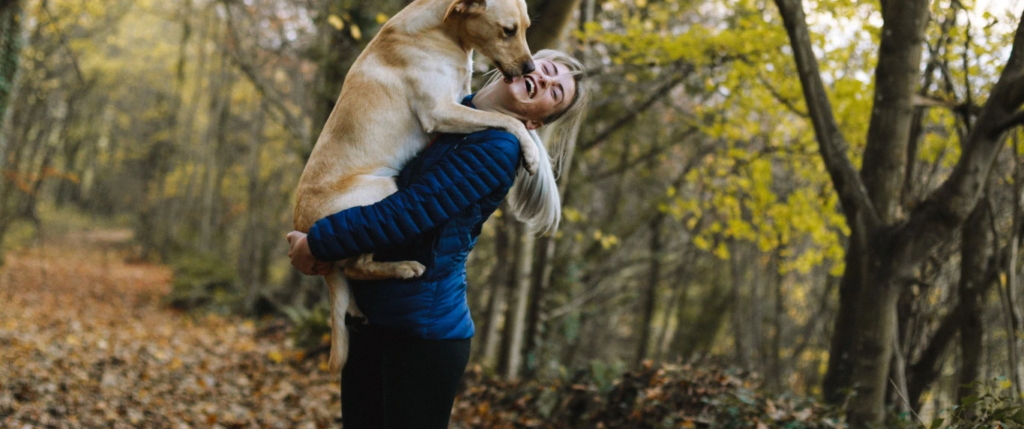
A mounting body of research has found that when dog-owners are faced with stressful situations, their bodies tend to be less physiologically reactive when their pets are present. The unconditional support people get from their pups has a psychological impact and a physiological basis. In recent years, multiple studies have illustrated the many ways people’s dogs can provide comfort, calm their frazzled nerves, be good listeners, and provide other forms of valuable support, proving that sometimes words are simply not necessary.
“Our dog companions are very predictable and reliable—the unconditional love we get from our dogs gives us a sense of security,” says Evangeline Wheeler, a professor of psychology at Towson University in Maryland. “Dogs don’t judge you or criticize. They just sit there and look at you with loving eyes.”
This silent form of canine encouragement can have a calming effect when you’re anxious or under pressure, sometimes more than the presence of a human friend or partner does.

Canine vs. human support
When people were placed in situations where they were asked to perform mental arithmetic or endure a “cold pressor” test in which their hand is submerged in ice water, those who had their dog present had smaller increases in their blood pressure and heart rate than those who had a spouse or friend present, according to research in Psychosomatic Medicine.
More recently, a study in a 2023 issue of the journal Emotion had people engage in a stress-inducing task—involving adding numbers that flashed on a computer screen—then interact with their pet dog, color in a coloring book, or wait quietly for 10 minutes. Those who interacted with their pooches experienced a greater boost in mood and a greater reduction in anxiety than those who waited or tried to destress by coloring.
“Your dog is providing nonjudgmental social support—you know your dog isn’t judging you for stressing out or being a wimp,” says study coauthor Hannah Raila, a psychologist and assistant teaching professor of psychology at UC Santa Cruz. “If your dog is sitting there wagging its tail, you could catch positive emotions from the dog.”
Similarly, in a study in the journal Society & Animals, researchers had 223 people undergo the Trier Social Stress Test (TSST), which requires participants to make a presentation and subsequently take an unanticipated mental arithmetic test in front of a panel of people who don’t provide feedback or encouragement. When people performed the TSST in the presence of a companion dog, they had lower stress levels, as measured by blood pressure and heart rate, and less anxiety.
In terms of how dogs can provide their humans with a level of comfort that other people can’t, “there’s a raw honesty you can have with your dog that you can’t always have with other people,” says Lori Kogan, a counseling psychologist and a professor in the clinical sciences department at Colorado State University. “We accept them so completely as they are—and they do the same for us and they’re consistent about it.”

The benefits of talking to Fido
It’s common for people to chat with their dogs throughout the day—about what each other is doing or how cute or playful or mischievous the pup is. It’s a gentle reminder of what’s meaningful. “When you talk to your dog, you get a sense of this is why you’re here—no matter what happens at work or with your finances, your dog still loves you and needs you and that gives you a sense of purpose,” says Larry Young, an expert on the neuroscience of social bonding and a professor of psychiatry at Emory University.
Research has found that talking to your dog about emotionally fraught issues can be particularly beneficial. In a study in a 2018 issue of Anthrozoös, researchers found that people are more willing to confide in their dogs about difficult emotions, such as depression, jealousy, anxiety, apathy, and fear, than they are with their romantic partners or friends.
The precise reasons for this aren’t known but one hypothesis is that “pets are good, nonjudgmental listeners because they don’t interrupt or reply,” says study coauthor Daniel Mills, a specialist in human-animal relationships and a professor of veterinary behavioral medicine at the University of Lincoln in the United Kingdom. “A dog won’t try to fix the problem the way some people do.”
There’s value in simply expressing emotions, especially troublesome ones. Research has found that when people put their emotions into words, their negative feelings become less intense, both subjectively and neurologically by calming the response of the amygdala, which is responsible for processing fear, anxiety, and other intense emotions.

Your relationship with your dog is a safe space because your dog won’t judge you or disagree with you. “Humans have a need to talk and articulating how you’re feeling is quite important in resolving your feelings,” Mills says. “By verbalizing it, you can start to make sense of it, as opposed to having it float around in your head. Expressing [those feelings] helps you move on from the past and into the future. There’s a liberation that comes with that.”
Another hidden perk: Your dog isn’t going to engage in a conversation about what’s bothering you, which could lead you to ruminate about it. They’re more likely to distract you. “Dogs use emotionally manipulative strategies,” Mills says. “Their desire to play is incompatible with you being subdued or angry.”
When you’re interacting, you can both get a surge of oxytocin (often called the “love hormone” or the “cuddle hormone”), which decreases the stress response in the short term, Young says.
Further support for this phenomenon comes from a study in a 2022 issue of the International Journal of Environmental Research and Public Health that found that when people interact with their dogs while teleworking, it replenishes the humans’ self-regulatory resources—by engaging in micro-breaks to pet their pup, the people are able to relax and rejuvenate—in ways that interacting with unfurry family members doesn’t.
“Dogs are fantastic at reading us—they can sense when we’re upset—and they are arguably better at reading us than some people are,” says Kogan. And “because we intuit that our dogs read us so well, we regulate ourselves so as not to upset our dogs, which is helpful for us as well.” It’s a positive feedback loop.